
Ocular Anatomy
Agency: Creative Perspectives, Inc. Client Partner: The Wellington Group for AMO
A foundational program that provided in-depth sales training on ocular anatomy, physiology, optics, and refraction across multiple product divisions. Designed for digital delivery and scaled for an international sales force across eight languages, modules combined rich illustrations, dynamic animations, and interactive learner touchpoints to streamline complex medical concepts and build foundational product readiness.
Strong Suit: Proven track record of pairing strategic instructional design with hands-on development to build high-impact learning programs from concept to global launch.
Project: Ocular Anatomy Online Learning Module

Foundational Training
This module served as a foundational program on ocular anatomy and vision, establishing the baseline required for subsequent product-specific training across multiple business lines. To manage the information-dense content, material was systematically chunked and organized into intuitive learning pathways—enabling sales reps to absorb complex concepts efficiently and demonstrating high knowledge retention in post-training assessments.
Essential Information
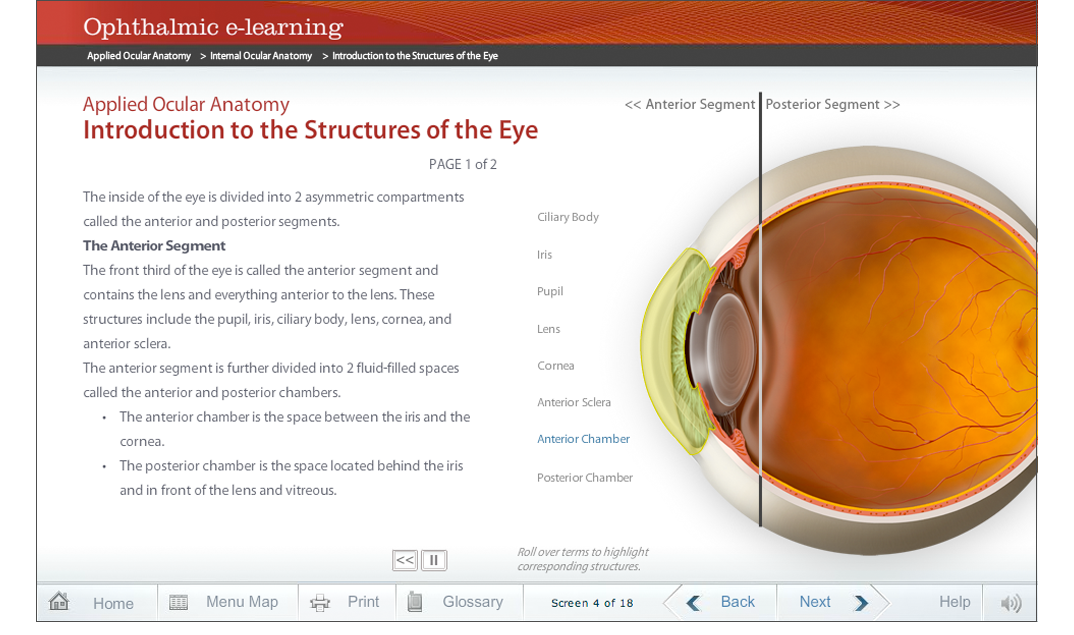
Covering ocular anatomy basics served as the primary building block for the curriculum. Learning objectives focused on identifying key anatomical structures and mastering the core mechanics of vision. To support visual learning, interactive screens featured rollover highlighting and dynamic structure identification, allowing learners to actively explore complex anatomy.

Rich-media Content
Short animated videos and dynamic media assets were integrated throughout the module to reinforce complex concepts. For example, visualizing refraction within the context of vision helped learners intuitively grasp foundational optical principles, accelerating comprehension and retention for subsequent, product-specific training.

Media-supported Self-checks
Short section assessments allowed learners to evaluate their understanding incrementally before the final exam. Integrating visual prompts into these checks bridged raw recall with practical application—reinforcing key anatomical structures to promote active recall and improve long-term retention far more effectively than text-only quizzes.

Localized Training
Supporting an international sales force was a required aspect of this training. The module was localized into 8 languages/locales—French, German, Italian, Spanish, Korean, Japanese, Simplified Chinese, and Traditional Chinese—featuring fully localized text and native voiceovers.

Results & Technical Implementation
All localized modules were rigorously tested on SCORM Cloud for cross-platform compliance and seamless data tracking before being deployed to the corporate LMS. To measure learning outcomes and drive completion, a comprehensive final exam (also localized) was integrated to evaluate retention, track uptake, and report learner success across global divisions.
My Role:
Implemented an iterative approach to design and development of the modules by producing a scaffolding pass on the program to gauge depth and breadth of the content in order to manage learner information load.
Worked with a SME on content development, assisted in storyboarding, and handled design of interactive learning elements.
Employed development skills of xml editing as well as graphic design and production skills.
Interfaced with the translation house to manage the process of localization into eight languages and played a key role in creating localized versions of the modules.