PERSPECTIVES ON AI AND ELEARNING
The Effort Has Moved
For most of my career, one of the most time-consuming parts of building great eLearning was related to media production and building complex learning programs. Today AI can handle much of that work, and the time it frees up goes back into what matters most: the learner, the design, and getting the content right.
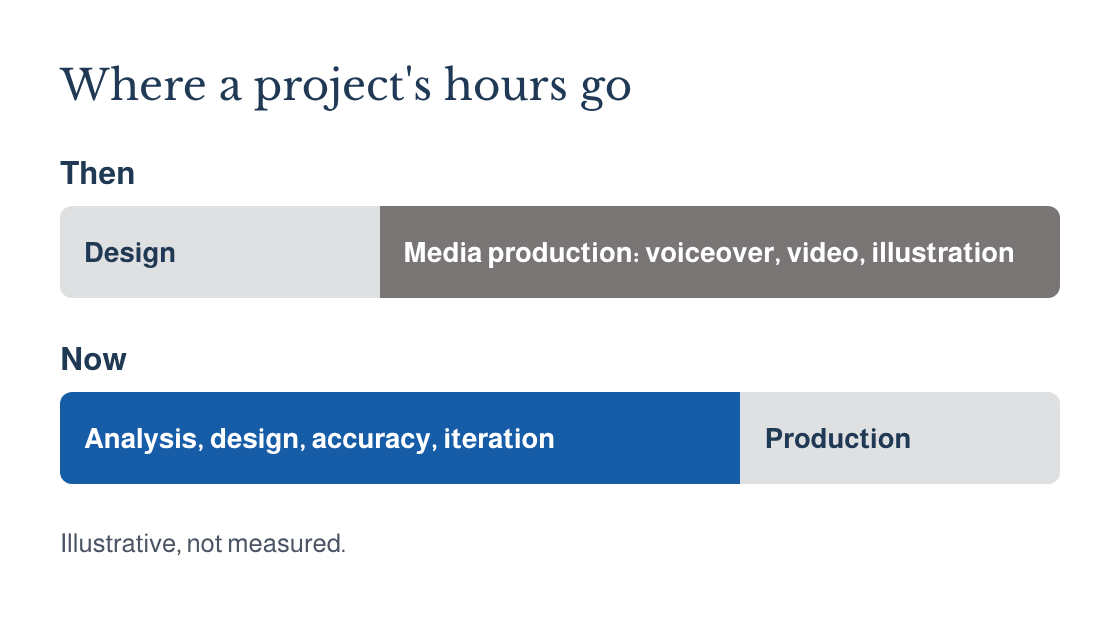
From production to judgment: how AI changed my work
THEN
Where the effort used to go
When I founded Creative Perspectives, rich media was the most expensive part of any project. Professional voiceover meant studio sessions, scheduling and re-records for every script change. Custom illustrations and animations took weeks. Localizing a single course into eight languages meant coordinating translators, native voice talent and a separate production pass for each version.
Those costs shaped the design because they imposed limitations of time and resources. Clients often had to choose between the experience they wanted and the budget and timeline they had. Every revision to narration or video pushed the schedule out further.
NOW
AI is built into the tools
Storyline, Rise and today's LMS platforms all include AI-assisted authoring. Work that filled whole weeks now takes a fraction of the time.
Narration: WellSaid and Amazon Polly. 60 narration files in about a minute.
Images: consistent characters and custom visuals with AI image tools.
Drafting: Claude, NotebookLM and Gemini turn source material into first drafts.
Technical: JavaScript, web objects and production scripts.
Where my effort goes now
The time didn't disappear. It moved to the work that decides whether learning changes what people do.

Understanding the problem
Time with SMEs and source material to find the real performance gap

Designing practice
Branching scenarios and simulations that look like the job.
Getting it right
Every AI draft checked against the source, especially regulated content.
Iterating
Prototype early, test with stakeholders, improve the design.


My ground rules for AI
AI drafts. I design. Every output passes through a human review gate before it moves forward.
Every output is a first draft. AI gets me to a starting point fast. It never ships without my review.
The source is the authority. I check AI drafts against the original documentation, not against what sounds right. AI can be confidently wrong, and it takes subject knowledge to notice.
Give it the right context. The best results come from giving the model the actual source material and clear direction, then refining the output instead of accepting the first answer.
Follow the client's rules. Organizations have different policies on where AI can be used. At Hanover Research, I used AI for images, narration and SME planning tools, and kept it out of course content, as the company required.
Keep the human parts human. Decisions about the learner, the performance problem and what good practice looks like are mine to make.